Tuesday, 17 January 2012

The Olympic Torch

Throughout this project I am trying to remain aware of other Olympic designs therefore I have decided to take a closer look at the Olympic Torch for 2012.


The Olympic Torch is made from a golden aluminium alloy and is pierced with 8,000 circular holes which represents the 8,000 torch bearers and 8,000 miles that will be carrying the torch around the UK over 70 days. 

The torch represents the best of British, using British designers, engineers and manufacturers. The British theme and the representation of the holes for the communities and people carrying the torch shows symbolism similar to those that I want to see within my final piece. The torch has been heavily criticised for not being eco-friendly and the design itself has been questioned by critics. However, whether the torch is the most beautiful, least eco-friendly or most criticised; it still pulls opinion from people and whether bad or good, people having an opinion on the piece is better than them having no opinion at all. 

Understanding what the torch stands for is much more important than liking it.


John Lovely


A welder from Arizona has designed a messy metal tree, John Lovely created an 8 1/2 foot tall tree which started as basic branches and was then added to. It was built up from a flat metal base which provided a strong and secure platform for the tree to grow from. The final piece is a stunning mix which initially looks incredibly messy but taking a step back and look at the overall effect it creates a beautiful piece.


Monday, 9 January 2012

Written on the Leaves


One of my original ideas was to write the award winners name etc onto the leaves that can then be attached to the tree. A similar idea has been used at the Raoul Wallenberg Memorial in Budapest, it has over 5,000 Holocaust victims names engraved onto the leaves as a commemoration. This tree is meant to be a lasting memory and is a similar design idea to what i want to create. The symbolism of the names on the leaves is the congratualatory, history and experience I want to capture within the piece for Frederick Gent School. 

Recycled Flowers


Christine Eige has done some interesting floral displays by recycling tin cans, The use of the materials create extremely attractive final pieces. Unfortunately I am interested in the long lasting factor and these materials would be difficult to keep looking good for a long period of time. However, the use of the metal and the colours is extremely eye catching and I am interested by the iconic company names that can be seen as well. Although it seems to be quite an easy material to use the sharpness of cut tin means it can be very dangerous and would therefore be a little dangerous for a school courtyard.


Tuesday, 3 January 2012

2012

Having entered the year of the London Olympics it seems that the country has got even more excited about the prospect of the 2012 Olympic Games. 


Whilst thinking about sculptures and 2012 Olympics it is worth looking at the sculpture that will soon  become the tallest UK sculpture and will actually wit within the Olympic and Paralympic Park in London. The piece will be called the ArcelorMittal Orbit and will contain a viewing platform which will be 114.5 metres tall. Made from 2,000 tonnes of steel and designed by Anish Kapoor and Cecil Balmond the sculpture will give visitors views of 20 miles from the viewing platform. 

This piece has the foundations of what I hope to achieve with Frederick Gent School (although in a much smaller scale), the designer Anish Kapoor expresses that;

 “the ArcelorMittal Orbit has been conceived as a structure made-up of discreet elements which seek to engage the viewer in experience through form, colour and reflectivity. The work invites public participation and engagement."

These wishes of engagement and experience are very similar to what I hope to achieve using student, teacher and community participation as an actual element of the piece itself. Materials, interaction, form and function are all areas which must combine to create the final piece. 

Saturday, 31 December 2011

The Olympic Rings

"The emblem chosen to illustrate and represent the world Congress of 1914...: five intertwined rings in different colours - blue, yellow, black, green, and red - are placed on the white field of the paper. These five rings represent the five parts of the world which now are won over to Olympism and willing to accept healthy competition."

Baron Pierre de Coubertin, August 1912 edition of Olympique


The Olympic Rings have been a vital part of the Olympics since the 1920's Olympic Olympic Games in Antwerp, Belgium. At least one of the colours of the rings can be found in every countries flag around the world and therefore represents the World uniting to play the games. 

Due to restrictions upon the use of the Olympic rings I have had to email the International Olympic Committee to request the use of the rings I will report here when I hear the response but have included my email to them below.


Dear Whomever May be Concerned,

I am emailing to request permission to use the Olympic rings within some of my work. I am currently working with Frederick Gent School in Derbyshire, England on a 'Get Set' project looking at how the school can continue the Olympic Legacy into the future. The young people at the school are hoping to have a final piece that will be a seating/sculptural piece that will sit within the schools central courtyard. I myself have been brought in to complete the project and designing, as I am a local undergraduate from Nottingham Trent University and will be completing the project as part of my final degree. As the project is Olympic based I would like to have permission to use the Olympic rings within the final piece to ensure that it is clearly recognisable as an Olympic Legacy Structure. The school will continue to use this piece to award members of the school and the community for work and actions which fulfil the Olympic and Paralympic Values. 

Name:                Hannah Louise Barker
Email:                hannahbarker@hotmail.com
Organisation:    Nottingham Trent University
Context:            Sculpture (probably made of galvanised steel or copper)
Content Use:    Permanent School Sculpture

Please do let me know if you require any other information.

Kind Regards,

Hannah Barker 

Wednesday, 28 December 2011

Olympic and Paralympic Values

The project is based upon the 'Get Set' Government Project to produce a legacy for the 2012 Olympics. The Olympic and Paralympic Values are the foundations to ensuring fair, successful and enjoyable games for all those who compete and watch. Frederick Gent School wish to celebrate these qualities by giving awards for people throughout the school and within the community that display the values of the Games. 

These values are as follows:

Olympic Values
  • Respect 
  • Excellence
  • Friendship
Paralympic Values
  • Courage
  • Determination
  • Inspiration
  • Equality
Therefore I want to ensure that the values that are so important to the project are maintained and shown clearly within the final piece. I want to look closely at the games, their influence and how this influence has been used within similar projects. Part of the idea of the 2012 Olympics is to ensure that the legacy is good and that at least 80% of the Olympic Games structure, content etc can be reused again. At the moment 98% is set to be reusable. I would like to ensure that the project will reflect these values and ensure that the legacy lives on for longer than just the Olympics 2012.


Queen Elizabeth Gates - Hyde Park


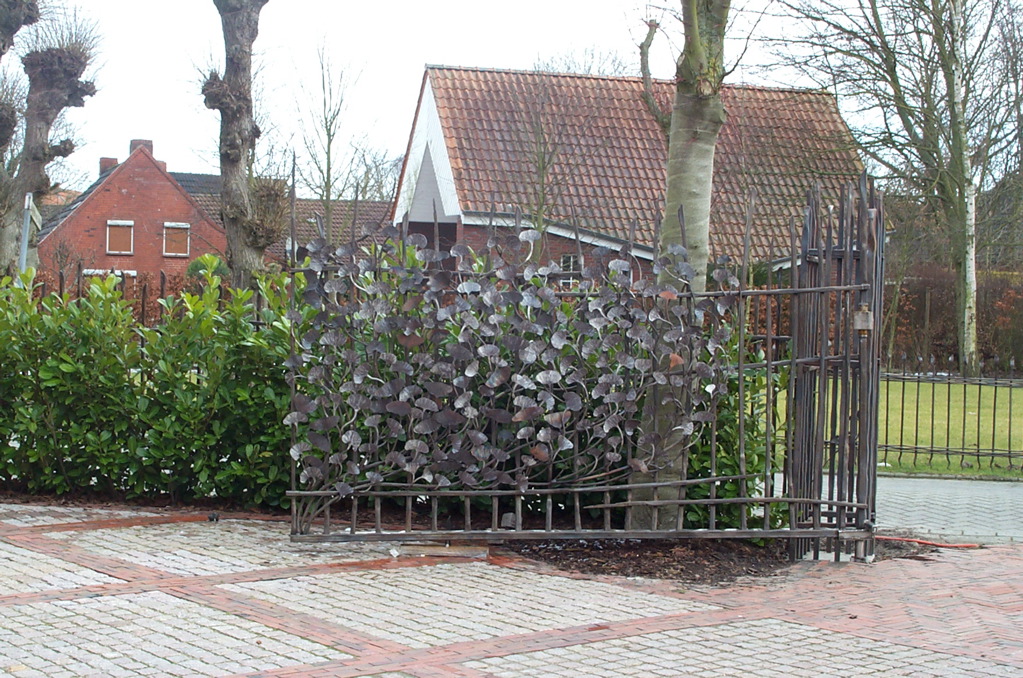
For those of you who have seen these gates they are a magnificent sight. Intricately shaped and swirling with leaves, flowers and all made from stainless steel and bronze. Designed by Giusseppe Lund they are designed to encompass design from the century by incorperating symetrical lower section which evolves into an organic freedom at the top.


 Giusseppe Lund has done some similarly fabulous work in other replaces across the world. I have placed some images of these below. This use of metal for the flowers, leaves, winding stems etc are a beautiful representation of nature. I believe this could work within the school setting at Frederick Gent School and has given me several ideas for the final ideas.


Sunday, 11 December 2011

Inspiration from nature

Taking inspiration from nature is a common occurrence in products, whether its from jewellery to furniture design, designers often use shapes, images and materials from the nature around them to create interesting and new products, clothes, objects etc.


Using the natural curves, shapes, patterns and materials create some amazing pieces and I wish to do the same within the final piece for the sculpture. Natural objects are wonderfully diverse in the shapes and patterns they create.

Whilst out and about I always keep an eye out for anything unusual or interesting. Whilst taking my dog for a walk I found a very unusual twisting shape of some dead ivy. The way they intertwine and curl around each other could be an exciting and interesting formation for metal to twist around the outside of the lighting structure that is already there and needs to remain.


Wednesday, 7 December 2011

Roxy Paine


I was talking to my cousin about the project and she remembered that  there was a tree statue in Washington DC's National Gallery of Art's Sculpture Garden. It is called 'Graft' and is designed by Roxy Paine, the piece is made from Stainless steel and weighs 16,000 pounds.

This got me looking at the artist/designer and it seems he has done a few similar pieces including 'Conjoined' in Madison Square, New York City, 'Maelstrom' on the roof of the Metropolitan Museum of Arts and 'Inversion' at the Art Basel, Switzerland.


The following video shows how 'Maelstrom' was installed on the roof of the Metropolitan Museum of Arts:  http://www.youtube.com/watch?v=td_NVTJaah8


Saturday, 26 November 2011

The Space


Within the school they have a large courtyard area which I think is perfect for a big Olympic Legacy Structure and could be greatly enhanced with an injection of colour. The space is a lot larger than I originally expected however I think there is a lot of potential. Having spoken to the site manager at Frederick Gent School it has been agreed that the light will remain where they are and that the structure/sculpture will be built around it. It is worth noting that the final product must allow access to the base of the lighting as this is where the fuses etc need to be changed. This is a vital point to remember throughout any further sketch work as it is essential to fulfil the needs of the space.